
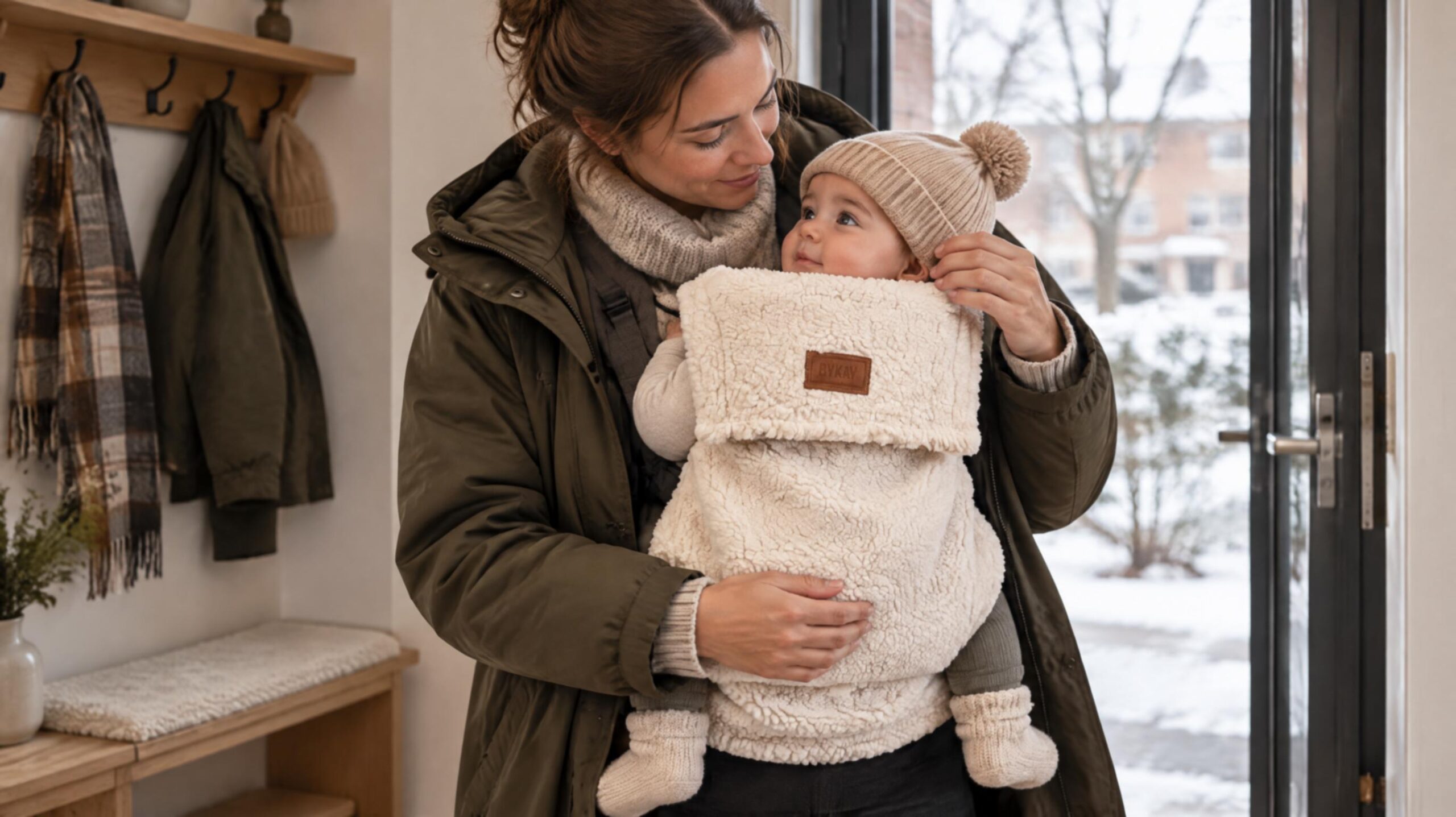
A short winter errand can turn into a surprisingly long departure. There are coats, zippers, mittens, carrier straps, and the question of whether your little one will be too warm the moment you step into a heated shop or daycare.
Learning how to dress baby in a carrier for winter starts with treating the carrier setup as part of your child’s layering. Rather than putting bulky outerwear underneath the carrier, use breathable indoor clothes, add small weather accessories, then place warmth around the carrier. It is a simple routine that can make getting out the door feel more manageable.
The goal is not to race a clock. Think of this as a roughly minute-long sequence you can repeat: dress, secure, insulate, and check.
The winter errand struggle
A thick snowsuit can seem like the obvious answer for cold weather. But for a quick walk to the car, a grocery run, or a daycare drop-off, it can add a lot of bulk before your baby is even in the carrier.
That bulk matters because your body heat and the carrier fabric already create warmth around your child. Once you move indoors, the same padded layers that felt useful outside may become uncomfortable. Thick clothing can also make it more difficult to check that your carrier fit remains snug and your child’s position is easy to see.
There is an important related safety principle for any strapped gear: fluffy winter clothing compresses under a harness. The American Academy of Pediatrics’ winter car-seat guidance explains that puffy padding can compress and leave too much space beneath harness straps. A baby carrier is not a car seat, but the same practical habit is useful: avoid relying on thick, compressible clothing beneath straps, and check your baby’s fit carefully after dressing them.
The rules of winter babywearing layering
For everyday cold-weather outings, start with the layers your baby would comfortably wear indoors. A breathable base layer, such as a bodysuit and pants, gives you a flexible starting point. From there, you can add weather-appropriate accessories such as a hat, mittens, and booties.
Then count the warmth already in the setup:
- Your baby’s everyday clothing
- The fabric of the carrier or sling
- Your own body heat when carrying close
- An insulating layer placed around the carrier
This approach to babywearing winter layering keeps the warmest, fluffiest layer outside the carrier straps instead of packed underneath them. It also makes the indoor transition easier: remove the outer insulation when you arrive, rather than trying to remove a full snowsuit while your child is still settled in the carrier.
For a very cold day, a short errand and prolonged time outdoors are not the same situation. Dress for the conditions, your route, and the time you expect to be outside. An inlay is intended to add warmth for regular carrier use; it is not a substitute for appropriate planning or extreme-weather gear during extended exposure to freezing temperatures.
A quick departure routine
Here is a practical sequence for leaving the house without building your entire outing around winter gear.
1. Start with comfortable indoor clothes
Dress your baby in breathable everyday layers. Add a warm hat, mittens, and booties as needed for the weather. These smaller accessories are easy to remove when you go indoors and do not add thick padding beneath the carrier straps.
2. Secure your baby in the carrier
Place your child in the carrier according to its instructions and make your usual fit checks. Your baby should be close enough for you to monitor easily, with their face visible and their breathing pathways completely clear.
3. Add warmth around the carrier
Once the carrier is adjusted, add an external insulating layer. This is the key difference between dressing a baby for a stroller ride and dressing a baby for close carrying. The insulation sits around the carrier setup, helping retain warmth without requiring a thick jacket underneath the straps.
For parents looking for how to keep baby warm in a carrier without a snowsuit, this order can reduce the number of layers you need to put on and take off during a short trip.
Adding fast insulation with the Inlay Teddy Ecru
The Inlay Teddy Ecru is designed to add a soft insulating layer to a standard or summer baby carrier without requiring a separate winter carrier. Its 80% cotton and 20% polyester construction can help add warmth while allowing your child to stay in their regular indoor clothing.
For a structured carrier with shoulder straps that can be unclipped during setup, thread the straps through the inlay’s integrated elastic bands before putting your child in the carrier. Once the carrier is set up, the inlay stays positioned as an added layer around your baby.
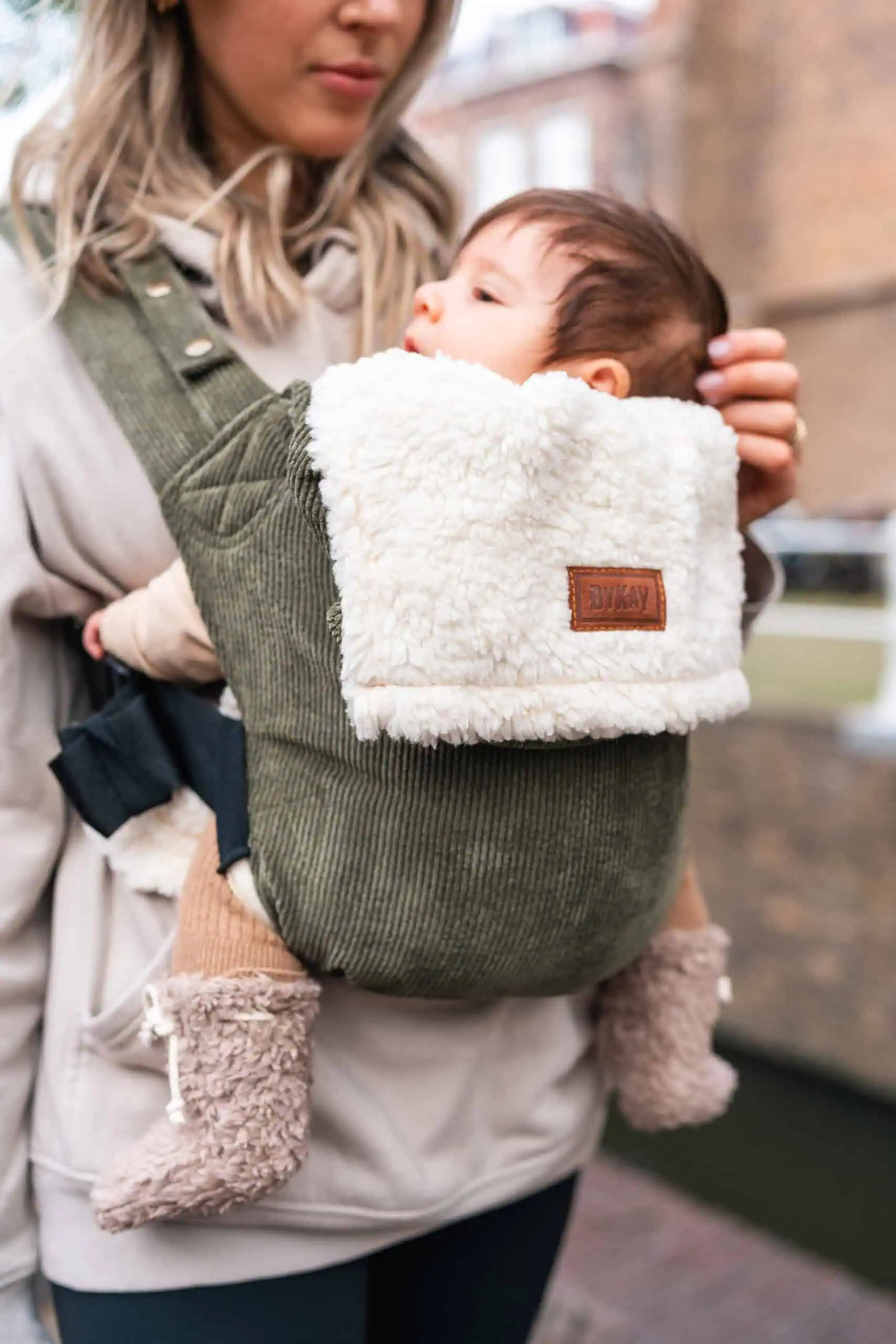
For a wrap or sling with straps that do not unclip, the inlay can rest loosely between the fabric layers instead. There is no need to force an attachment method that does not suit your carrier. The tuckable design gives you an option for wraps and slings while the elastic loops suit compatible structured carriers.
If you are deciding which style of carrier works best for your routine, our comparison of ring slings and baby wraps can help you consider their different everyday setups.
Important airway and temperature checks
Warmth should never get in the way of visibility. Keep fabric away from your baby’s face and make sure their nose and mouth remain completely clear throughout the outing. Check them regularly, especially after adding or removing layers.
A simple temperature check is to feel the back of your child’s neck. It should feel comfortably warm, not hot or sweaty. If they feel too warm, remove an accessory or the external inlay promptly. Their hands and feet can feel cooler than their core, so use the back of the neck as your main quick check.
When you enter a heated indoor space for more than a moment, remove the external insulation to help prevent overheating. This is one of the advantages of a baby carrier winter insert: it is easier to adjust an outer layer than to undress a baby from a bulky one-piece suit while managing bags, doors, and a carrier.
A calmer way to head outside
Winter babywearing does not have to mean a long battle with a snowsuit before every small errand. Start with breathable indoor layers, secure your baby carefully, add warmth outside the carrier, and check their face and temperature as you go.
For a quick babywearing winter routine, the Inlay Teddy Ecru offers a practical insulating layer for compatible carriers, wraps, and slings. Explore the Inlay Teddy Ecru to add flexible warmth to your existing carrier setup for everyday cold-weather outings.

